
1st International Workshop on
Digital and Sustainable Practices for Cultural Heritage: Intersection of digital innovation and Sustainability in cultural heritage.
December, 2025 – January 2026 | Online
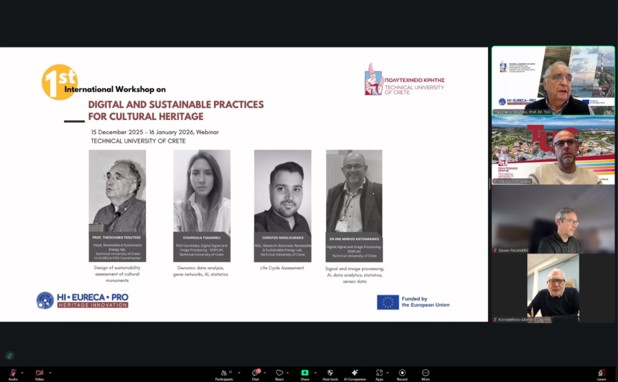
The 1st International Workshop on “Digital and Sustainable Practices for Cultural Heritage” successfully concluded, connecting digital documentation technologies with approaches to the sustainable management of cultural heritage.
Organised by the Renewable and Sustainable Energy Systems Laboratory (ReSEL@TUC) and the Digital Signal and Image Processing Laboratory (DISPLAY) of the Technical University of Crete, within the framework of HI-EURECA-PRO, the workshop comprised five online sessions delivered in December 2025 and January 2026.
The programme engaged 55 participants and received 93% positive feedback overall.
Connecting heritage data with digital technologies
The first four sessions followed a progressive learning pathway covering open data, optical data acquisition and analysis, 3D mapping, and the development of digital twins.
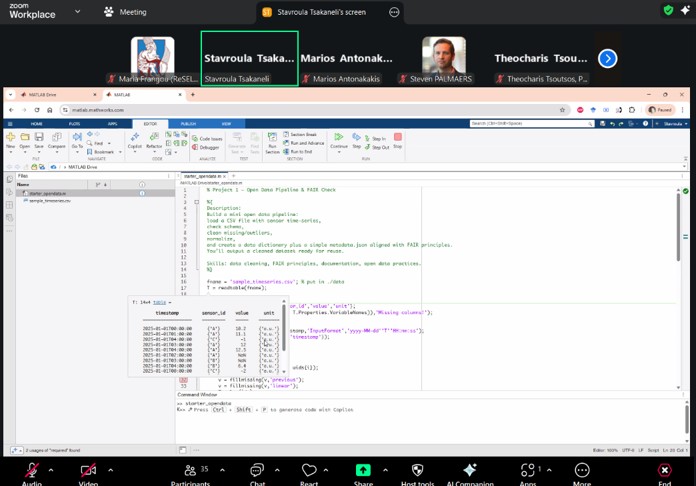
The opening session explored how accessible, well-structured, and reusable data can support research and cultural heritage practices. Participants were introduced to metadata standards, licensing frameworks and the FAIR principles—Findable, Accessible, Interoperable and Reusable—alongside examples from digital heritage collections and European data platforms. Discussions also addressed ethical issues, equitable access, and the responsibilities associated with sharing and reusing data.
The programme then examined optical imaging technologies, including multispectral and hyperspectral imaging, LiDAR and drone-based acquisition, together with methods for processing and analysing the resulting data. Heritage applications illustrated how these technologies can support pigment analysis, damage detection, digital restoration, and archaeological site identification.
Building on this foundation, the 3D mapping session presented the workflow from point-cloud generation and processing to mesh creation, texture mapping and visualisation. Participants explored how choices between photogrammetry, laser scanning, and other capture methods depend on the scale, accuracy requirements and resources of each heritage application.
The digital twins’ session examined how digital representations can be connected with data from the physical environment to support monitoring, restoration planning, and the assessment of environmental impacts. Attention was given to interoperability, data governance, and the computational demands of these systems.
Turning digital knowledge into sustainable management decisions
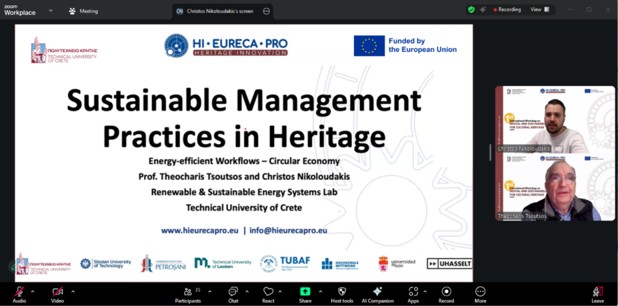
The final session, “Sustainable Management Practices in Heritage: Energy-efficient Workflows – Circular Economy”, connected the technical content with practical decision-making for heritage projects.
Participants were introduced to life-cycle thinking and Life Cycle Assessment as approaches for identifying environmental impacts and avoiding interventions that shift burdens from one stage or activity to another.
A five-steps sustainability assessment methodology guided participants through identifying priority needs, establishing a Local Action Group, developing an Action Plan, defining implementation procedures, and monitoring and evaluation. An applied example demonstrated practical outputs, including stakeholder mapping, the selection of feasible interventions, implementation planning and environmental, economic and social indicators.
The session also explored energy efficiency, circular economy practices and sustainable digital archiving, highlighting the environmental implications of uncontrolled data storage.
Supporting skills for the green and digital transition
Through theoretical foundations, cross-domain case studies and applied sustainability assessment, the workshop connected the capture and interpretation of heritage data with the decisions needed for its long-term preservation and management.
Delivered within the HI-EURECA-PRO Cultural Heritage Demo Site in Crete, the initiative supported interdisciplinary upskilling and knowledge exchange, emphasising that digital innovation should respond to clearly defined heritage needs while accounting for environmental, ethical and social considerations.
The course presentations and recordings have been made publicly available through the HI-EURECA-PRO website, extending the programme’s value as an open learning resource for students, researchers, practitioners and heritage stakeholders.
See more: https://www.hieurecapro.eu/digital-and-sustainable-practices-for-cultural-heritage/