
Cutting-edge knowledge and practical insights on sustainable materials applied to cultural heritage
Module 2: Sustainable Materials Applications
The second module of the “Material Sustainability in Cultural Heritage Patents” workshop series was held on October 23, 2025. Titled “Sustainable Materials Applications”, the session was organized by the Renewable and Sustainable Energy Lab of the Technical University of Crete (ReSEL@TUC), with the support of the University of León, within the framework of the HI-EURECA-PRO project. The speaker panel featured distinguished experts and researchers from across Europe, who shared cutting-edge knowledge and practical insights on sustainable materials applied to cultural heritage. The workshop gathered 60 participants -including researchers, technology transfer officers, policymakers, and heritage professionals- offering them a unique opportunity to exchange experiences and explore innovative, sustainable approaches to heritage preservation.
The event was moderated by Professor Theocharis Tsoutsos, (Technical University of Crete), who warmly welcomed participants and outlined the session’s objectives. In his opening remarks, Prof. Tsoutsos emphasized the growing urgency of adopting sustainable practices in cultural heritage conservation amid increasing environmental pressures. He highlighted the need for interdisciplinary collaboration to develop solutions that harmonize cultural preservation, economic feasibility, and environmental responsibility.
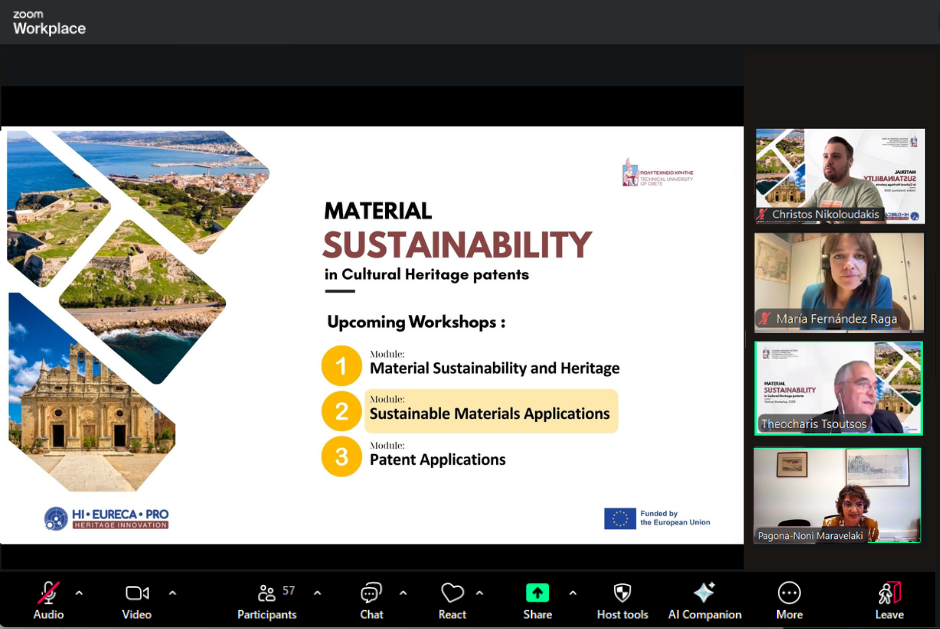
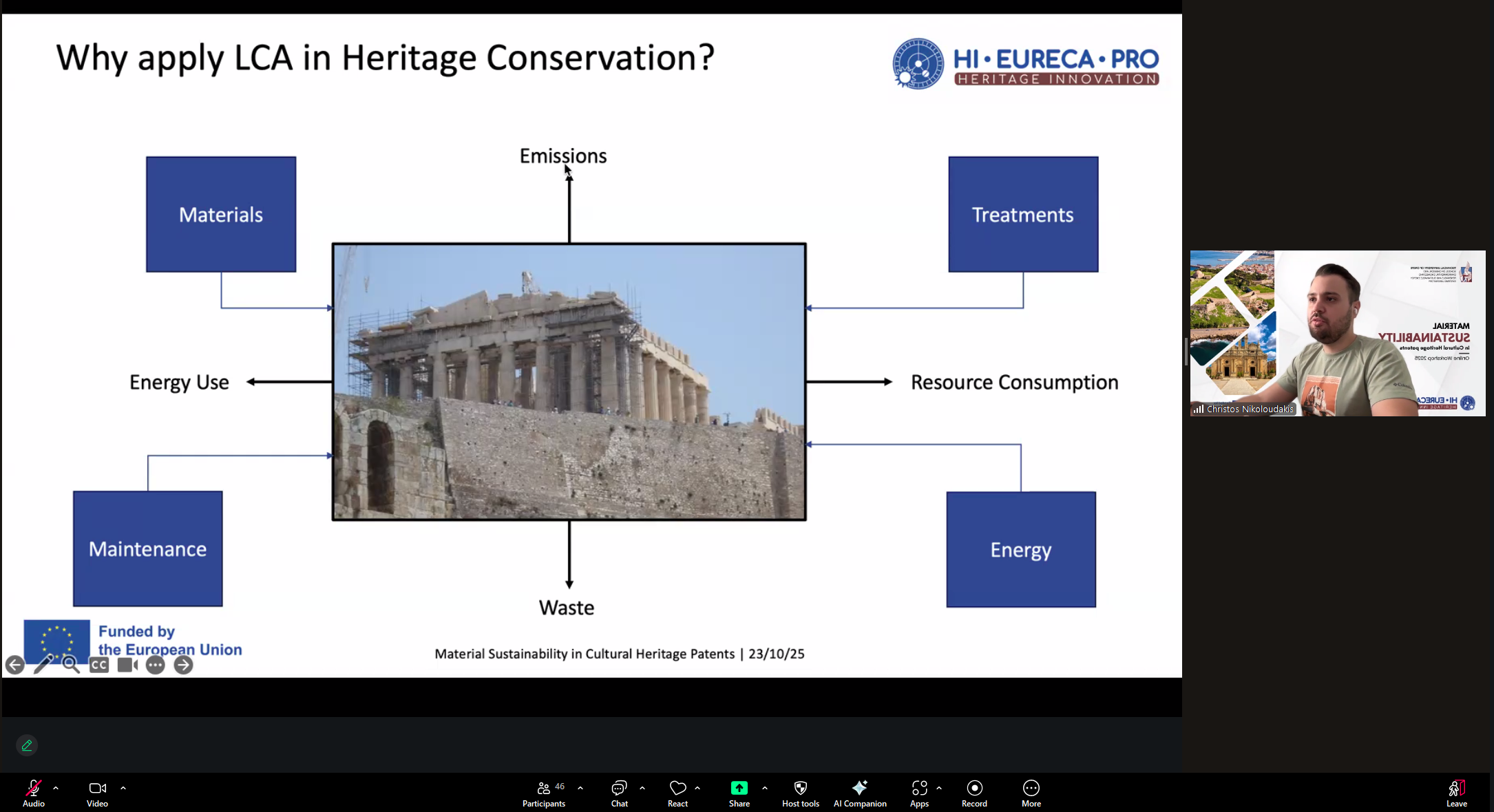
The workshop featured a series of insightful presentations covering key areas in material sustainability, beginning with Life Cycle Assessment (LCA) in Heritage Conservation and Christos Nikoloudakis, (Renewable and Sustainable Energy Lab), who presented the principles of Life Cycle Assessment (LCA), and its applications in heritage conservation. Through case studies, he demonstrated how LCA supports informed decision-making, comparing traditional and innovative materials.
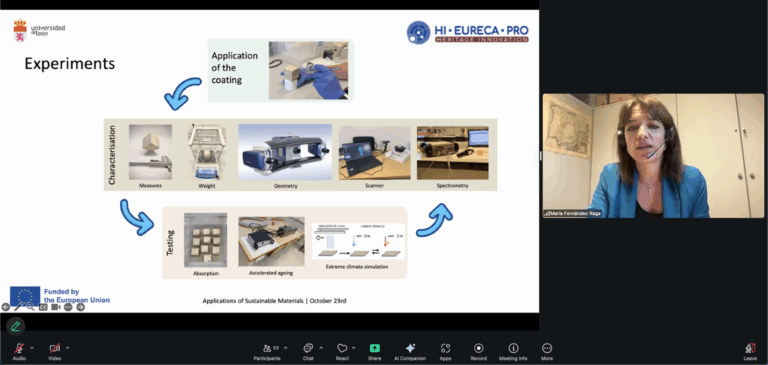
Prof. María Fernández Raga, (Universidad de Leon), shared cutting-edge research on nanotechnology applications for protecting heritage stones. Representing the Nanoshield research group, she presented novel nanomaterials designed to improve the durability and sustainability of conservation treatments. Her presentation also introduced advanced testing techniques, including rainfall simulation and non-destructive evaluation, to better assess material performance under real-world conditions.
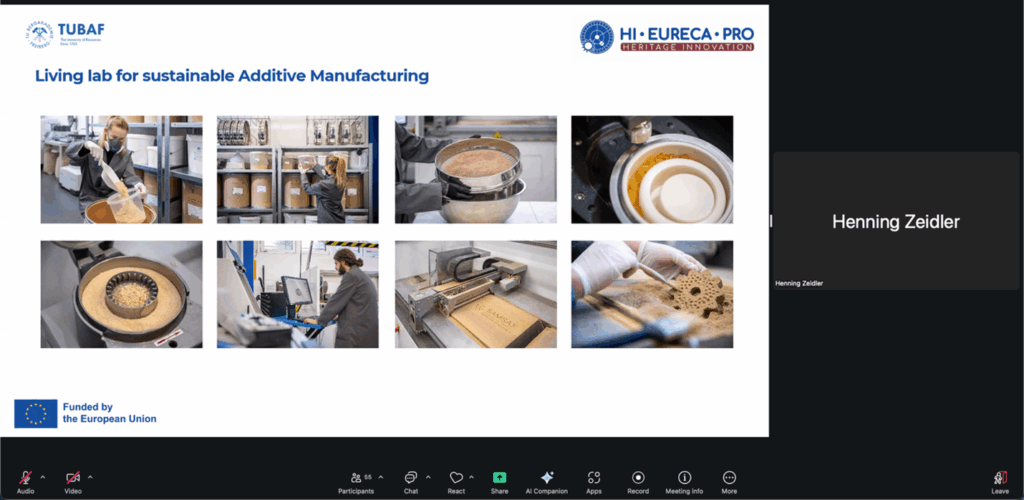
Prof. Henning Zeidler (University of Freiburg), discussed the role of additive manufacturing in promoting sustainability. He showcased projects utilizing agricultural by-products and invasive species as feedstock for 3D-printed materials. Dr Henning Zeidler also introduced the Living Lab concept—a collaborative environment connecting researchers, farmers, and industry partners to explore the use of waste materials in circular manufacturing systems.
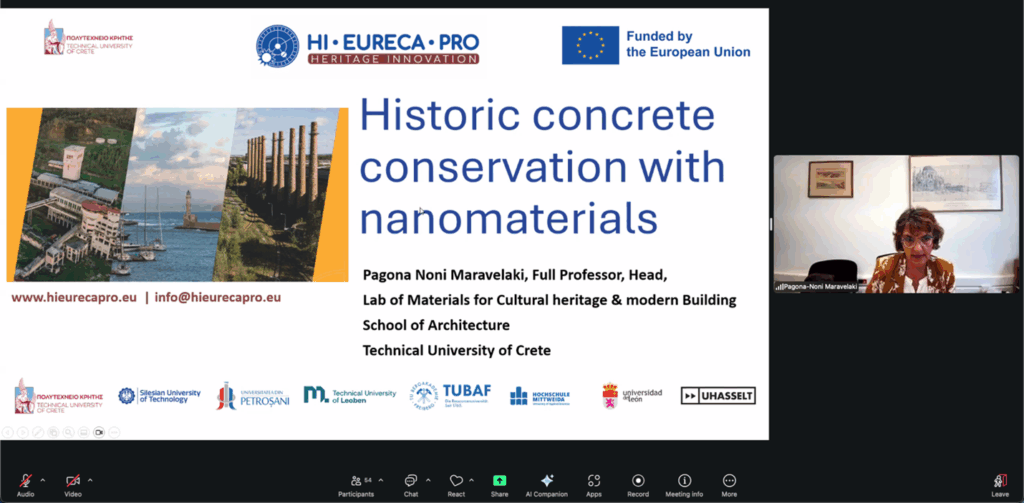
The session was concluded by Professor Pagona-Noni Maravelaki, (Technical University of Crete), with a presentation on nanomaterial-based conservation strategies for concrete heritage structures. Prof. Maravelaki detailed advanced treatments that improve the properties of concrete, supporting both preservation and sustainability goals. Her research, aims to develop scalable solutions for heritage restoration.
Throughout the session, participants engaged in discussions addressing the integration of LCA in heritage practices, the challenges of material testing and standardization, and the future potential of sustainable composites for conservation.
Before closing, Prof. Tsoutsos thanked all speakers and attendees for their valuable contributions and announced that the upcoming final module of the series will focus on knowledge valorisation skills related to patent applications.